
Kingston Council wants every new HMO to need planning permission from early 2027. Councillors decide on 18 November, and about 1,900 HMOs already exist.
Turning a family home in Kingston into a small shared house could soon need planning permission. The council wants to remove the right to do it without asking, across the whole borough, from early 2027.
Councillors on the Place Committee will decide on Wednesday 18 November at 7.30pm. The council announced the plan on 10 November.
What would change
A house in multiple occupation, or HMO, is a home shared by unrelated people who share a kitchen or bathroom. Today the rules split by size:
- 3 to 6 people (a “small HMO”): a house or flat can be converted without planning permission, under national permitted development rights.
- 7 or more people: planning permission is already needed.
The council proposes an Article 4 Direction, a legal order that withdraws that permitted development right. Every future conversion of a home into a small HMO would then need a planning application, wherever it is in the borough.
It would be an “immediate” direction. That means it takes effect the day it is made, with no notice period. The committee report says a 12-month warning “could potentially lead to an influx of HMO conversions” before the rules bite.
The direction would not ban HMOs. The report says it “would not prevent HMOs from being established where planning permission is granted”.
How many HMOs Kingston has
The council’s evidence paper puts the borough’s known or predicted HMOs at 1,901. That is:
- about 2.5% of all homes in the borough
- about 8.5% of privately rented homes
Only 453 were on the council’s licensing register in August 2026. The paper says the gap is partly because some HMOs do not need a licence and some run without one. It adds that a large number of licences expired from 2021, after Kingston did not renew its additional licensing scheme, and many of those homes are likely to have kept operating as HMOs.
Most licensed HMOs are small. In the register’s January 2026 breakdown, 347 of them, 77%, were licensed for five or six people. Those are exactly the size that can be created today without planning permission.
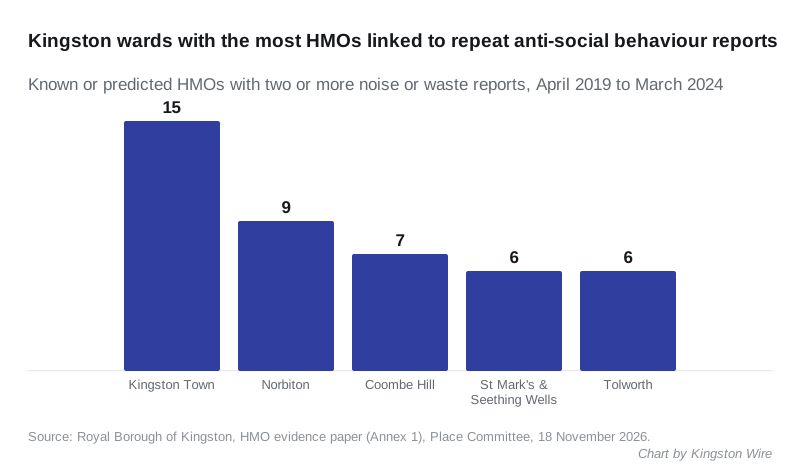
The highest concentrations are in Kingston Town, Norbiton and St Mark’s and Seething Wells wards, according to the evidence paper. Renting has grown fast: the share of Kingston homes rented privately rose from just under 16% in 2001 to over 27% in 2021.
The problems the council links to HMOs
The evidence paper looked at noise and waste complaints recorded between April 2019 and March 2024 that could be tied to a known or predicted HMO.
- 382 anti-social behaviour incidents were linked to HMO addresses.
- Kingston Town recorded the most (74), then Norbiton (67).
- About 81% were about noise.
- 67 HMOs drew two or more reports over the five years.
Housing conditions are the other concern. The modelling predicts about 266 HMOs, 14% of the total, have at least one serious hazard under the national housing health and safety rating system. The paper says the private rented average nationally is 10%.
The council is careful about what these figures show. The report says they “do not, by themselves, establish that HMO occupation caused each individual incident or problem”. The hazard figures come from predictive modelling, not inspections.
Why borough-wide
Officers considered a direction covering only the busiest wards. They rejected it because HMOs are spread across the borough and the council cannot count them all. A partial ban could push conversions into the streets just outside it, the report says.
Councillor Andrew Wooldridge, who leads on planning policy, said shared housing “is a valued part of Kingston’s housing mix, providing a vital lower-cost accommodation option for residents”. He said the aim was to “manage the quality, number and location of HMOs”.
The risk for the council
An immediate direction carries a cost risk. For the first 12 months, an owner whose HMO application is refused, or approved with tight conditions, can claim compensation under the Town and Country Planning Act 1990.
The report says four London boroughs that brought in immediate directions told Kingston they have had no compensation claims, despite refusing some applications.
What happens next
| Stage | Timing |
|---|---|
| Place Committee decides | Wednesday 18 November 2026, 7.30pm |
| Legal drafting and notices | Winter 2026/27 |
| Direction made and in force | Early 2027 |
| Six-week public consultation | Straight after it is made |
| Committee considers responses | Spring 2027 |
| Final confirmation | Within six months of it being made |
If the council does not confirm it within six months, the direction lapses and the old rights return.
Separately, the draft Kingston Local Plan 2028 to 2043 proposes policy KH6. It would cap HMOs at 10% of homes within 100 metres, stop a family home being “sandwiched” between two HMOs, and allow no more than two HMOs side by side. That policy is still to be examined and is not in force.
What it means for you
- If you own a home and plan to let it as a shared house: a conversion done before the direction is made does not need permission under today’s rules. After it is made, you will need to apply. The council has not yet given an exact date.
- If you rent a room in a shared house: nothing changes for existing HMOs. Licensing rules for five or more sharers still apply.
- If you live near HMOs: you will be able to comment on future conversions through the planning register, as with any other application. Our Kingston planning news page explains how.
- To have your say now: the committee meeting is open to the public and livestreamed from the meeting page. The formal consultation comes after the direction is made.
Have your say