
ONS figures show 540 Kingston businesses closed and 520 opened in the first half of 2026. Sir Ed Davey says the Budget's business rates change falls short.
More businesses closed than opened in Kingston in the first half of 2026: 540 closures against 520 openings, a net loss of 20. The figures come from the Office for National Statistics and were sent to us by Sir Ed Davey, the Liberal Democrat MP for Kingston and Surbiton, who says local firms are “still waiting with bated breath” for help after the Budget.
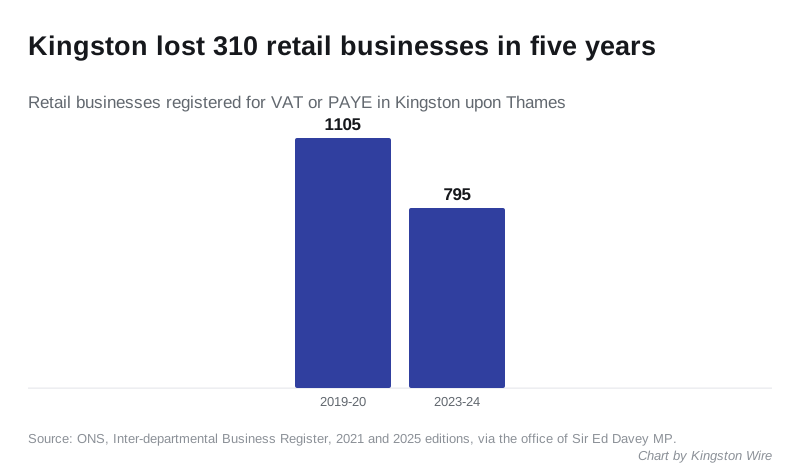
The same data set shows the number of retail businesses in the borough fell from 1,105 to 795 between 2019-20 and 2023-24, a drop of 310, or 28%. Across London the fall was 3%.
The figures
The spreadsheet Sir Ed’s office shared is built from ONS business demography statistics and the Inter-departmental Business Register. It counts businesses registered for VAT or PAYE, and the figures cover the whole Royal Borough of Kingston upon Thames, which is a wider area than the constituency.
- January to June 2026: 520 businesses opened and 540 closed, a net change of minus 20.
- January to March: 260 openings and 290 closures, minus 30.
- April to June: 260 openings and 250 closures, plus 10. The second quarter was better than the first.
- Neighbours over the same six months: Richmond upon Thames was down 55, Merton and Sutton were each down 15. London as a whole gained 840 businesses.
The longer run is where Kingston stands out. In the same spreadsheet:
| Businesses in Kingston | 2019-20 | 2023-24 | Change |
|---|---|---|---|
| Retail | 1,105 | 795 | -310 |
| Accommodation and food | 415 | 455 | +40 |
| Arts, entertainment, recreation and other services | 520 | 595 | +75 |
So the borough gained cafés, restaurants, pubs and leisure businesses while it lost shops. Over the same period Richmond upon Thames lost 20 retail businesses, Sutton gained 15 and Merton gained 80. London lost 1,360 out of 44,635.
What Sir Ed says
According to his office, the Chancellor announced in the Budget on 27 October that the threshold for high street business rates relief will rise from £12,000 to £18,000. Sir Ed says this “does not go far enough” for business owners in Kingston and Surbiton.
“The Chancellor promised ‘breathing space’ in this budget but businesses in Kingston and Surbiton are still waiting with bated breath,” he said.
“After decades of neglect by the Conservatives, this Government completely missed the opportunity to turn the tide and failed to back local businesses. A meagre increase in the threshold for business rates doesn’t touch the sides for many high street businesses that are being forced to shut up shop due to the compounding effects of costs.
“The Liberal Democrats is the only party that is providing a real solution to the cost-of-living crisis, is backing local businesses with a hospitality VAT cut, and would put money back in people’s pockets to spend in our town centres.”
The Post Office closures
His office names two closures in particular: the Post Office on Victoria Road, Surbiton and the one on North Parade, Chessington. It says Sir Ed has met the Post Office and local stakeholders to try to get services running again in both places.
Other shops are going too. Fabric Land closes its Old London Road shop on Saturday 28 November.
What the Liberal Democrats propose instead
The party says it would have spent £14.1bn on cost-of-living measures between November 2026 and April 2028, £5.6bn in 2026-27 and £8.5bn in 2027-28. Its high street policy and the release set out three parts:
- Cutting VAT on hospitality, accommodation and attractions from 20% to 15% for 17 months, which the party puts at about £7.8bn, using HMRC figures given in a written parliamentary answer. It also wants an overhaul of business rates and a smaller employer National Insurance bill.
- An “Essential Energy Guarantee”: every household would get a discounted rate on an allowance equal to half of Ofgem’s medium annual usage, with extra for families with children, disabled people and the poorest households. The party says the middle fifth of households would save about £100 a year and the poorest fifth about £140. The idea was first proposed by the Joseph Rowntree Foundation. Cost: £4.3bn.
- Cheaper travel for three months at first: fuel duty cut by 10p (12p a litre at the pump, the party says), bus fares capped at £1 instead of £3, rail fares cut by 10% and VAT on public electric car charging cut from 20% to 5%. Cost: £2bn for three months.
The party says this would save the average household £350 over 17 months, assuming half of the hospitality VAT cut is passed on to customers. It would pay for it with a windfall tax on banks’ earnings from Bank of England reserves (£7.8bn, it says, based on OBR figures), a clawback of what Citizens Advice estimates is £6.3bn to £7bn of excess profit made by energy network companies by 2028, and extra oil and gas tax receipts from higher fuel prices.
These are the party’s own costings and have not been independently checked.
What it means for you
- If you run a small shop, pub or café, the rise in the business rates relief threshold to £18,000 is the change announced in the Budget, according to Sir Ed’s office. Kingston Council’s business rates team can tell you whether your rateable value qualifies.
- If you used the Victoria Road or North Parade Post Office, Sir Ed’s office is the place to ask about progress: 21 Berrylands Road, Surbiton KT5 8QX, 020 8288 2736.
- The full ONS figures for Kingston and every other council are in the spreadsheet.
Have your say